







An eCommerce Integration Use Case for Growing Magento Stores
For many Magento and Adobe Commerce merchants, the online storefront is only one part of the buying experience.
Behind every order, the store may need to communicate with ERP systems, inventory tools, payment platforms, order management systems, and internal business workflows.
That becomes more complex when the store needs to support unique selling rules, such as:
- Mixed cart handling
- Partial payment workflows
- Special service items
- Multiple fulfillment methods
- Store-specific delivery logic
- Backend order routing
- Customer-specific payment rules
- Legacy system synchronization
When these workflows are not planned properly, the customer experience can become confusing and the internal operation can become harder to manage.
This use case focuses on how a Magento store can align a modern eCommerce storefront with complex backend workflows while keeping the buying journey simple for shoppers.
The goal was not to expose complex business rules to the customer.
The goal was to make the storefront easier to use while ensuring the backend systems still received the right order, payment, fulfillment, and customer data.
When Complex Business Logic Starts Affecting the Storefront
As Magento stores grow, business rules often become more advanced.
A standard order may be simple, but many stores need to support orders that include different product types, delivery methods, payment options, and backend routing requirements.
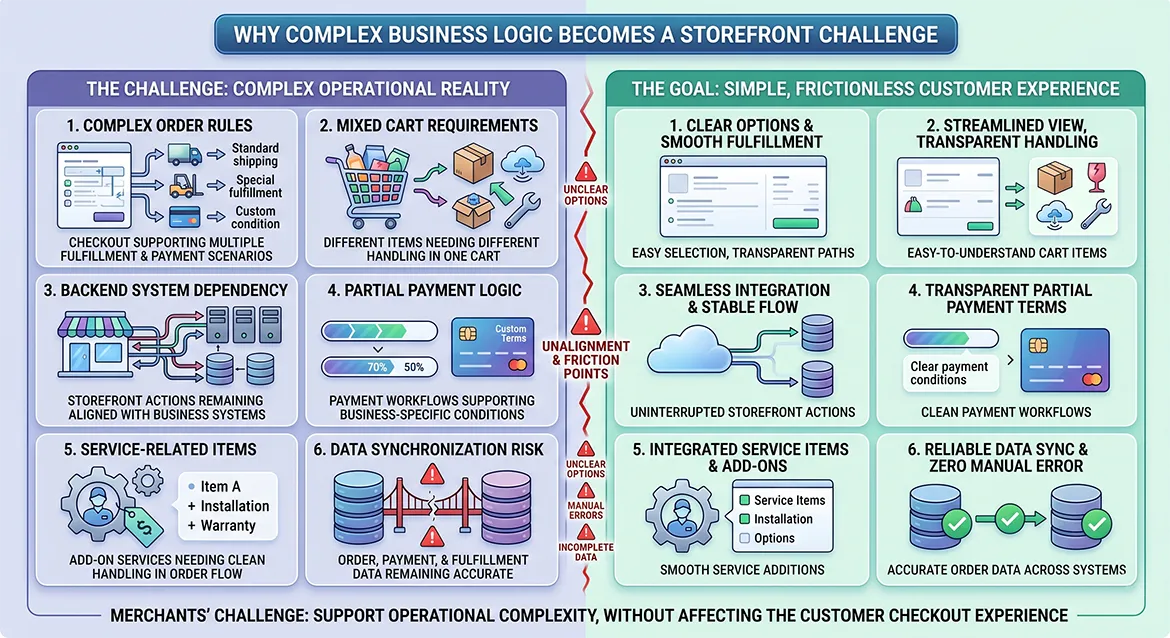
A single cart may include products that follow different rules.
For example, one item may need standard shipping, another may require special fulfillment, and another may include a service-related charge or custom payment condition.
If the storefront and backend systems are not aligned, these rules can create friction.
Customers may see unclear options, internal teams may need to correct orders manually, and backend systems may receive incomplete or mismatched data.
What This Meant for the Business
| Challenge | Business Impact |
|---|---|
| Complex order rules | Checkout needed to support multiple fulfillment and payment scenarios |
| Mixed cart requirements | Different items in the same cart needed different handling |
| Backend system dependency | Storefront actions had to remain aligned with business systems |
| Partial payment logic | Payment workflows needed to support business-specific conditions |
| Service-related items | Add-on services needed clean handling inside the order flow |
| Data synchronization risk | Order, payment, and fulfillment data needed to remain accurate |
For merchants, this creates a real challenge.
The store needs to support operational complexity, but the customer should not feel that complexity during checkout.
The Core Problem: Storefront Simplicity vs. Backend Complexity
The issue was not that Magento could not support complex workflows.
The issue was that the store needed to balance two very different priorities.
On the customer side, the buying journey needed to be clear, fast, and easy to complete.
On the backend side, the order needed to follow specific business rules, payment logic, fulfillment paths, and system requirements.
When these two sides are not connected properly, problems can appear across the business:
- Checkout confusion
- Incorrect fulfillment paths
- Payment workflow gaps
- Manual order corrections
- Backend data mismatches
- Delayed order processing
- Higher support workload
- Reduced customer confidence
The goal was to create a more reliable connection between the Magento storefront and the backend systems without making the customer journey feel more complicated.
The Integration Strategy
1. Mapping Business Rules Before Changing the Storefront
The first step was understanding how the business actually needed orders to behave.
Before improving the integration, it was important to map the rules behind different order types, payment conditions, fulfillment methods, and service-related workflows.
This helped define how the storefront should collect information and how backend systems should receive it.
Key areas reviewed included:
- Cart rules
- Product type handling
- Payment conditions
- Fulfillment logic
- Service item workflows
- Order routing requirements
- Customer data flow
- Backend system dependencies
This planning helped reduce the risk of changing the customer experience without understanding how it would affect operations.
Merchant Impact
| Before Rule Mapping | After Rule Mapping |
|---|---|
| Business logic was difficult to manage consistently | Order workflows became easier to understand |
| Checkout rules were tied to operational complexity | Customer-facing steps could be simplified |
| Backend dependencies created update risk | Integration needs became clearer |
| Internal teams relied on manual awareness | Workflows became easier to document and support |
For merchants, this step is important because complex workflows should be planned before they are automated or integrated.
2. Supporting Mixed Cart and Fulfillment Workflows
Many Magento stores need to support carts that contain different types of products or services.
That can create challenges when each item has a different fulfillment rule.
The integration approach focused on helping Magento recognize and organize these workflows more clearly so each item could follow the right backend path without confusing the shopper.
This included supporting logic for:
- Mixed cart scenarios
- Different fulfillment paths
- Service-related line items
- Backend order categorization
- Shipping and delivery rule alignment
- Order routing consistency
The customer still needed a simple checkout experience.
Behind the scenes, the store needed enough structure to ensure the right data was passed to the right systems.
Why This Matters for Merchants
| Workflow Need | Why It Matters |
|---|---|
| Mixed cart logic | Allows different product types to be purchased in one order |
| Fulfillment routing | Helps each item follow the right delivery or processing path |
| Service item handling | Keeps add-on services clear in the order flow |
| Backend order structure | Reduces manual correction after checkout |
| Customer experience continuity | Keeps checkout simple even when order logic is complex |
For merchants, the benefit is a smoother buying experience with fewer operational gaps behind the scenes.
3. Preserving Payment Flexibility Without Adding Checkout Friction
Payment rules can become complex when a store supports deposits, partial payments, special payment conditions, or account-based payment workflows.
The challenge is making these options available without creating confusion during checkout.
The integration approach focused on keeping payment options clear for shoppers while ensuring the backend systems could still receive accurate payment information.
This helped support:
- Partial payment workflows
- Payment condition logic
- Order balance tracking
- Payment method alignment
- Backend payment visibility
- Accurate order records
The goal was not to make payment logic more visible to the customer.
The goal was to make payment logic easier to complete and easier for the business to process.
Payment Workflow Impact
| Before Optimization | After Optimization |
|---|---|
| Payment rules were harder to manage consistently | Payment workflows became more structured |
| Customers could face unclear payment paths | Payment experience became easier to follow |
| Backend teams needed more manual review | Payment data became easier to process |
| Future payment improvements were harder to plan | Checkout foundation became more flexible |
For merchants, this helps support complex payment needs while keeping checkout more customer-friendly.
4. Connecting the Storefront With Backend Systems More Reliably
A modern Magento storefront often needs to exchange data with older or more complex backend systems.
That does not mean the customer should experience complexity.
The integration strategy focused on improving how order information, customer details, payment data, and fulfillment rules moved between the storefront and backend systems.
The focus areas included:
Rather than exposing backend complexity to shoppers, the goal was to create a cleaner bridge between the store and internal operations.
Before vs. After
| Before Integration Improvement | After Integration Improvement |
|---|---|
| Storefront workflows were difficult to align with backend rules | Business logic became more structured |
| Teams needed more manual coordination | Operational workflows became easier to manage |
| Complex orders increased processing risk | Order data became more reliable |
| Payment and fulfillment logic required extra review | Backend alignment improved |
| Customer experience could feel less clear | Checkout became easier to complete |
For merchants, stronger integration helps reduce friction for both shoppers and internal teams.
The Result: A Cleaner Buying Experience With Stronger Backend Alignment
By improving how Magento handled complex business logic, the store became better prepared to support advanced order workflows without making the customer experience harder.
The outcome was a more balanced commerce setup.
Customers could move through checkout more easily, while backend systems continued receiving the data needed to process orders accurately.
Improvement Area and Business Outcome
| Improvement Area | Business Outcome |
|---|---|
| Business rule mapping | Clearer workflow planning across checkout and backend systems |
| Mixed cart support | More flexible ordering without added customer confusion |
| Fulfillment logic alignment | Better handling of different delivery and processing paths |
| Partial payment support | More accurate payment workflows for business-specific needs |
| Service item handling | Cleaner order structure for add-on services |
| Backend system alignment | Reduced operational friction and manual correction risk |
| Customer experience improvement | A simpler checkout journey despite complex business rules |
Most importantly, the store no longer had to choose between operational accuracy and customer simplicity.
It could support both.
What Magento Merchants Can Learn From This Use Case
Complex business logic is common in growing Magento and Adobe Commerce stores.
As stores expand, they often need to support more products, more payment options, more fulfillment rules, more backend systems, and more customer-specific workflows.
The challenge is not only adding these capabilities.
The challenge is making them work together without slowing down checkout, confusing shoppers, or increasing manual work for internal teams.
Merchants should review how their store handles:
- Mixed carts
- Payment rules
- Fulfillment workflows
- ERP integration
- Order routing
- Service-related products
- Backend data sync
- Customer-facing checkout logic
The biggest takeaway is simple:
A strong eCommerce integration should make complex business logic feel simple for the customer.
When the storefront and backend systems work together properly, merchants can improve customer experience, reduce operational friction, and support more flexible buying workflows.
Is Complex Business Logic Slowing Down Your Magento Store?
If your Magento store is experiencing:
- Checkout confusion
- Manual order corrections
- Payment workflow issues
- Fulfillment routing problems
- Mixed cart limitations
- Backend data mismatches
- ERP integration gaps
- Order processing delays
- Service item handling issues
It may be time to review how your Magento eCommerce integration is supporting your business workflows.
At Rave Digital, we help Magento and Adobe Commerce merchants improve business logic mapping, checkout workflows, backend integration, order routing, and customer experience without making the store harder to manage.
Turn Complex Workflows Into a Smoother Buying Experience
Connect your storefront, checkout, payment workflows, and backend systems more effectively while keeping the buying experience simple for customers.