







AI Is Changing How B2B Buyers Discover, Compare, and Purchase
For B2B Magento and Adobe Commerce merchants, AI is no longer just a future-facing technology discussion.
It is already changing how buyers search for products, evaluate suppliers, compare options, request quotes, reorder frequently purchased items, and make buying decisions.
The shift is especially important for B2B eCommerce because business buyers rarely follow a simple purchase path. They often deal with contract pricing, bulk orders, approval workflows, technical specifications, account-specific catalogs, ERP-driven inventory, and repeat purchasing cycles.
That means AI has the potential to improve much more than product recommendations.
It can reshape the entire B2B buying experience.
But there is also a risk.
Many merchants are investing in AI tools before their commerce foundation is ready. If product data is incomplete, pricing logic is fragmented, inventory is unreliable, and integrations are disconnected, AI may only expose those weaknesses faster.
For Magento merchants, the real opportunity is not just adding AI.
It is preparing the store, data, workflows, and architecture for AI-driven commerce growth.
Why B2B Magento Merchants Should Pay Attention to AI Now
B2B buyers are becoming more digitally independent. They expect faster product discovery, more accurate recommendations, self-service tools, real-time data, and personalized buying journeys.
At the same time, AI is becoming more deeply embedded into search engines, commerce platforms, analytics tools, marketing systems, customer service workflows, and buying assistants.
For Magento and Adobe Commerce merchants, this creates a major shift.
The store is no longer competing only on product catalog, pricing, and checkout experience.
It is also competing on:
- How easily AI systems can understand product data
- How accurately buyers can find the right products
- How quickly repeat orders can be completed
- How personalized the buyer journey feels
- How efficiently backend workflows support self-service
- How well the store connects pricing, inventory, content, and customer data
- How ready the platform is for AI-powered discovery and agentic commerce
The merchants that prepare early will be better positioned to support modern B2B buyers.
The merchants that wait may find that their store becomes harder to discover, harder to personalize, and harder to scale in an AI-driven buying environment.
The Real Challenge: AI Needs More Than a Plugin
Many merchants think AI adoption starts with installing a tool.
But for B2B commerce, AI success depends heavily on the quality of the foundation behind the store.
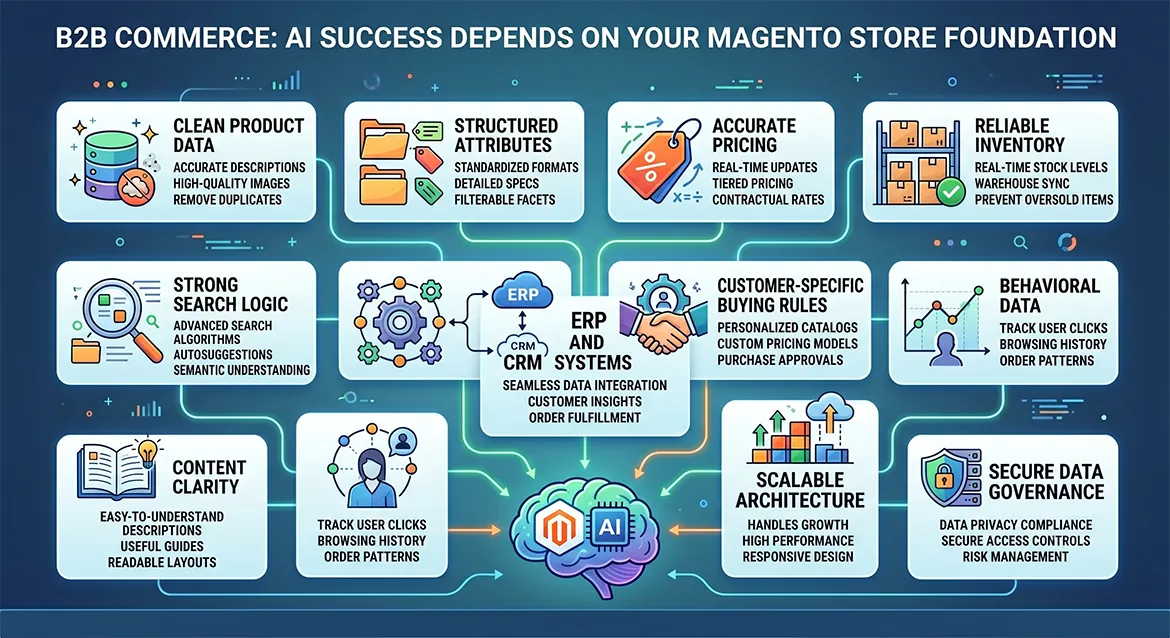
Without the elements in the image above, AI can produce weak recommendations, inaccurate search results, irrelevant personalization, poor automated responses, and unreliable buyer experiences.
That is why AI readiness for Magento should be treated as a commerce strategy, not just a technology upgrade.
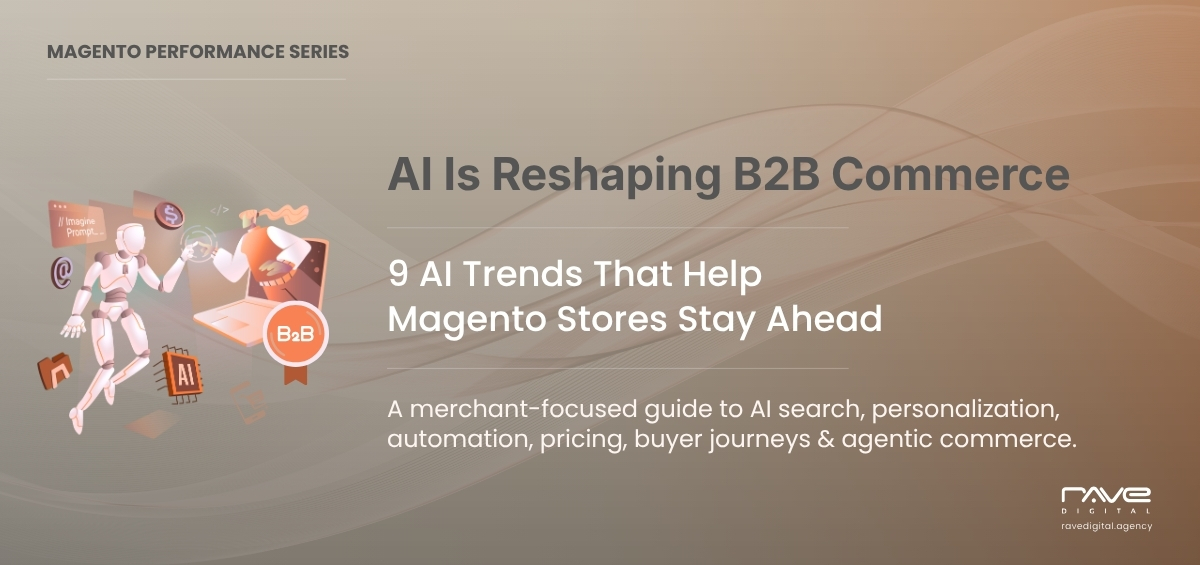
9 AI Trends Reshaping B2B Magento eCommerce
| AI-Driven Trend | What It Means for B2B Magento Merchants | Business Impact |
|---|---|---|
| AI-Powered Product Discovery | Buyers expect faster search, smarter filtering, semantic search, and product results based on intent. | Helps buyers find the right products faster and improves conversion opportunities. |
| AI Product Recommendations | AI can suggest relevant products based on behavior, purchase history, category interest, and reorder patterns. | Increases cross-sell, upsell, repeat orders, and average order value. |
| Agentic Commerce & AI Shopping Agents | AI agents may help buyers research, compare, shortlist, and even initiate purchases. | Merchants need structured data and clear product content to remain visible in AI-assisted buying journeys. |
| AI-Driven Personalization | Storefront experiences can adapt based on account type, buyer behavior, industry, location, and purchase history. | Improves buyer relevance, engagement, and account-level retention. |
| Predictive Reordering | AI can help identify when buyers may need to reorder based on past purchase cycles and usage behavior. | Supports recurring revenue and reduces friction for repeat B2B purchases. |
| Dynamic Pricing Intelligence | AI can support pricing analysis, margin protection, quote decisions, and competitive positioning. | Helps merchants improve pricing accuracy, profitability, and quote efficiency. |
| AI-Powered Customer Service | AI assistants can answer product questions, order status queries, quote questions, and support requests. | Reduces support workload and improves buyer self-service. |
| AI Workflow Automation | AI can assist with product enrichment, quote routing, inventory alerts, order updates, and backend task prioritization. | Reduces manual work and improves operational efficiency. |
| AI Search & Answer Engine Optimization | Buyers are increasingly using AI search tools and answer engines to research vendors and solutions. | Merchants need content that is structured, clear, helpful, and optimized for AI-driven discovery. |
AI Readiness Checklist for B2B Magento Merchants
Before investing heavily in AI tools, merchants should review whether their Magento store is ready to support AI-driven commerce.
| Area | What Merchants Should Review |
|---|---|
| Product Data | Are product titles, attributes, descriptions, SKUs, specs, and compatibility details complete? |
| Search Experience | Can buyers find products by SKU, use case, specification, synonym, or category intent? |
| Pricing Logic | Are customer-specific pricing, tier pricing, quote pricing, and ERP pricing accurate? |
| Inventory Accuracy | Is inventory data reliable across warehouses, ERP systems, and storefront visibility? |
| Customer Data | Are account groups, order history, buyer roles, and segmentation rules structured clearly? |
| Content Quality | Do product pages, FAQs, guides, and category pages answer buyer questions clearly? |
| Integration Readiness | Are ERP, CRM, PIM, OMS, payment, and shipping systems connected reliably? |
| Automation Controls | Are AI workflows monitored, reviewed, and governed properly? |
| Performance Architecture | Can the store handle AI-powered search, personalization, recommendations, and increased data activity? |
| Security & Governance | Are customer data, pricing data, and business rules protected when AI is used? |
How B2B Magento Merchants Can Start Preparing for AI
AI readiness does not require merchants to change everything at once. A better approach is to start with the areas that directly affect buyer experience and operational efficiency.
- Start with Product Data: AI depends on clean, structured information. Improve product titles, attributes, descriptions, specifications, compatibility details, and category structure.
- Improve Search and Navigation: Make sure buyers can search by SKU, product type, application, industry, feature, brand, and technical requirement.
- Strengthen Pricing and Inventory Accuracy: AI-powered personalization and automation cannot work well if pricing and inventory data are unreliable.
- Connect Backend Systems: ERP, CRM, OMS, PIM, and marketing systems should work together so AI tools can access accurate and consistent data.
- Build Better Buyer-Focused Content: Create content that answers real buyer questions, supports comparison, explains product use cases, and improves AI search visibility.
- Audit Performance and Scalability: AI features can increase data processing, personalization, search complexity, and integration demands. Magento architecture should be ready to support that added load.
Why AI Readiness Matters for Magento Growth
AI will not replace the need for strong commerce fundamentals.
It will make those fundamentals more important.
B2B Magento merchants that want to benefit from AI need to strengthen the foundation first:
AI can help merchants grow faster, but only when the store is ready to support it.
If the commerce foundation is weak, AI may create more confusion than value.
If the foundation is strong, AI can improve discovery, reduce friction, support self-service, and help merchants build more scalable digital buying experiences.
Final Takeaway: AI-Driven eCommerce Starts Behind the Scenes
For B2B Magento merchants, AI-driven growth is not just about adding smarter tools to the storefront.
It starts behind the scenes.
It starts with clean product data, accurate pricing, reliable inventory, connected systems, stronger search, better content, scalable architecture, and clear automation rules.
The future of B2B eCommerce will be shaped by buyers who expect faster discovery, more relevant recommendations, self-service journeys, AI-assisted research, and frictionless reordering.
Magento and Adobe Commerce merchants that prepare now will be better positioned to support those expectations.
The question is no longer whether AI will influence B2B commerce.
The real question is whether your Magento store is ready for how AI will change the buying journey.
Make Your B2B Magento Store Discoverable in AI Search
If your Magento or Adobe Commerce store is struggling with incomplete product data, disconnected integrations, manual workflows, pricing complexity, poor search performance, or backend limitations, it may be time to review your AI readiness.
At Rave Digital, we help B2B Magento merchants strengthen their commerce foundation with better data, smarter integrations, scalable architecture, automation planning, and performance optimization.
Prepare Your Magento Store for AI-Driven Commerce
Identify the gaps limiting your store’s ability to support AI-powered search, personalization, automation, and future-ready B2B growth.