








A Performance Infrastructure Use Case for High-Volume Magento Stores
As Magento stores grow, performance challenges become bigger than just page speed.
A growing store is not only serving product pages. It is also managing large catalog operations, inventory updates, customer sessions, checkout activity, third-party integrations, backend jobs, and traffic surges at the same time.
This use case focuses on a multi-million product Magento environment where the platform needed to support high-volume catalog activity, continuous backend processing, and customer browsing without overwhelming infrastructure.
The goal was not simply to make the site faster.
The real objective was to strengthen the full Magento performance architecture so the store could handle high traffic, large catalog updates, backend processing, and customer sessions more reliably.
Why Magento Performance Becomes More Complex as Stores Grow
For merchants, performance issues do not always appear as one obvious problem.
Sometimes the storefront feels slower. Sometimes checkout becomes inconsistent. Sometimes catalog updates take longer. Sometimes background jobs fall behind. Sometimes customers experience session issues without the business immediately knowing why.
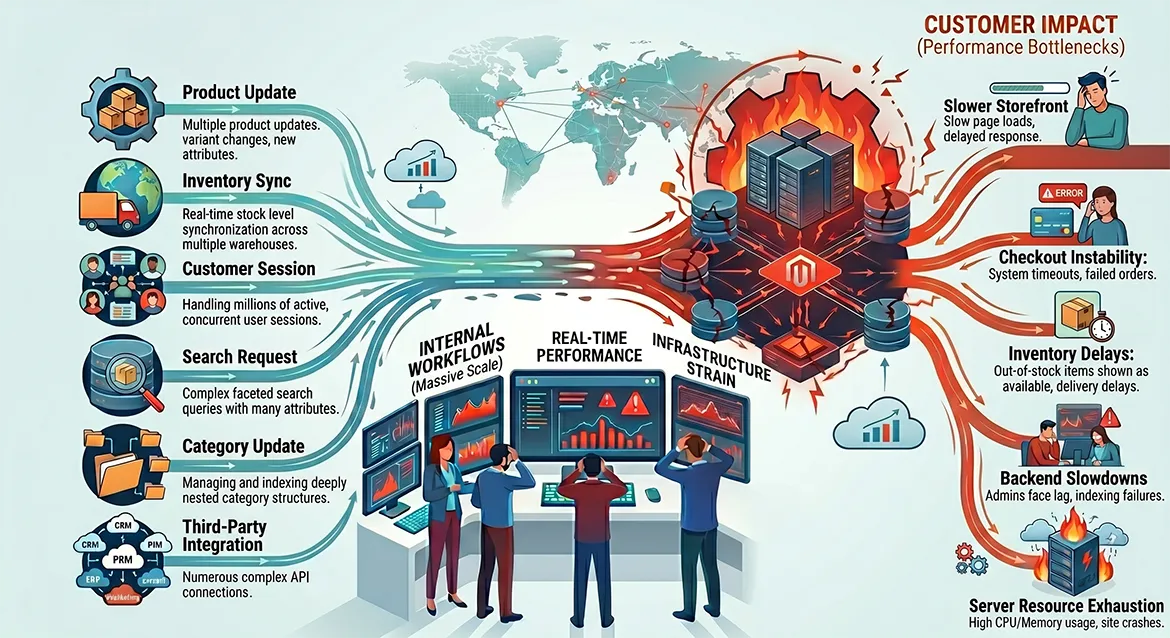
In large Magento and Adobe Commerce environments, these issues often happen because too many processes are competing for the same resources.
A growing Magento store may need to support:
When these workflows are not properly distributed, the result can be slower storefront performance, checkout instability, inventory delays, indexing slowdowns, and backend resource strain.
The Architecture Challenge: Too Much Pressure on Magento
One of the biggest performance risks in a growing Magento store is allowing too many requests and backend processes to reach the core application directly.
Every uncached request can place pressure on the origin servers. Every backend job can compete with customer activity. Every inefficient process can slow down other parts of the store.
For high-volume Magento environments, performance cannot depend on one quick fix. The architecture needs to handle requests at the right layer before they place unnecessary load on Magento.
The performance strategy focused on reducing pressure across multiple areas like caching, session handling, indexing, backend processing, traffic routing, failover readiness, and resource management.
The goal was to help the store handle more activity without forcing Magento to process everything directly.
The Performance Strategy: Layered Protection From Edge to Backend
Rather than relying on one performance improvement, the environment was strengthened across multiple layers.
Performance Architecture Flow
| Layer | Role in Performance |
|---|---|
| Cloudflare Edge Cache | Reduced requests reaching the origin and improved content delivery |
| Varnish Full Page Cache | Served cached HTML before requests reached Magento application nodes |
| Redis Backend Cache | Supported Magento backend cache and full page cache performance |
| Local Redis Cache on Web Nodes | Reduced internal network pressure and improved cache availability |
This layered structure helped reduce unnecessary strain on Magento and allowed the store to respond more efficiently during high-demand periods.
For merchants, this means the platform does not have to “work from scratch” for every request. More content can be served faster, while backend systems stay better protected.
Making Customer Sessions More Reliable
Performance is not only about how fast pages load.
For eCommerce merchants, session stability is critical. If customer sessions become unstable, shoppers may experience issues that directly affect the buying journey.
Session problems can create:
- Unexpected logout behavior
- Cart inconsistencies
- Checkout disruption
- Poor shopping continuity
- Lower customer confidence
To improve session reliability, the environment used Redis-based session management instead of standard file-based session storage.
Customer sessions were stored in a dedicated Redis instance, with failover redundancy available through Redis Sentinel if the primary cache server failed.
Why This Matters for Merchants
| Session Risk | Business Impact |
|---|---|
| Unstable sessions | Customers may lose shopping continuity |
| Cart inconsistencies | Checkout confidence can drop |
| Poor failover planning | Active shoppers may be affected during infrastructure issues |
| Weak session handling | Customer experience becomes less reliable |
These issues become especially important during high-traffic events, catalog updates, inventory synchronization, and third-party data syncing.
By improving session architecture, the store became better prepared to support shoppers during high-traffic and high-activity periods.
Removing the Bottlenecks That Slow Magento Down
As Magento stores scale, performance problems rarely come from one area alone.
Multiple infrastructure and backend bottlenecks can build pressure at the same time.
Main Bottlenecks and Business Impact
| Bottleneck | What It Could Affect |
|---|---|
| Database deadlocks | Order creation and invoicing |
| Indexing overload | Catalog update speed |
| PHP-FPM resource pressure | Dynamic request handling |
| Load balancer strain | Traffic routing efficiency |
| Cron and consumer issues | Background job reliability |
These issues are common in complex Magento environments because performance problems often come from multiple systems becoming overloaded together.
The improvement approach focused on reducing unnecessary strain, improving workload distribution, and keeping customer-facing activity protected from backend pressure.
Improving Catalog Processing Without Overloading the System
Large product catalogs create heavy indexing requirements.
When catalog updates, product changes, and inventory updates are processed in oversized batches, Magento can face memory pressure and backend slowdowns.
To improve stability, indexing workloads were handled in smaller, more manageable batches. Multi-threading was also used to help process scoped indexes more efficiently.
For merchants, this means catalog updates can be handled in a more controlled way.
Instead of forcing the system to process oversized jobs that create strain, workloads can be broken into smaller batches that are easier for the infrastructure to manage.
Merchant Benefit
| Before Optimization | After Optimization |
|---|---|
| Large indexing jobs increased memory pressure | Batch sizes were adjusted for better stability |
| Catalog operations created heavy backend load | Indexing became more controlled |
| Updates could slow other processes | Resource usage became easier to manage |
| Backend workload affected store operations | Catalog processing became more predictable |
This helped the platform process catalog changes more efficiently without placing unnecessary pressure on storefront performance.
Keeping Background Work From Blocking Storefront Activity
Magento stores often rely on background jobs for tasks such as inventory synchronization, product updates, third-party syncing, queue processing, and data updates.
But if these jobs fall behind or stop running properly, operational delays can build up quickly.
To improve background processing reliability, queue consumers were managed through Supervisor. This allowed consumers to run continuously, automatically restart on failure, and reduce dependency on timing-based cron execution.
Why This Helped
| Problem | Improvement |
|---|---|
| Missed cron schedules | Consumers ran continuously |
| Queue jams | Background processing became more reliable |
| Manual recovery risk | Failed workers could restart automatically |
| Delayed operations | Resource management improved |
For merchants, this means backend work can keep moving without creating unnecessary delays or disrupting the customer experience.
Strengthening Traffic Handling at Critical Layers
In high-volume Magento environments, traffic handling is not only about the number of visitors.
It is also about how efficiently the infrastructure routes requests, serves cached content, manages SSL, balances load, and prevents unnecessary work from reaching Magento.
A stronger traffic-handling layer helps support:
- Peak traffic periods
- Promotional campaigns
- High-volume browsing
- Complex catalog navigation
- Checkout activity
- Search and category traffic
- Backend processing peaks
When traffic is handled more intelligently, Magento can remain more stable during high-demand periods.
The Result: A More Resilient Magento Environment
By improving the performance architecture across caching, session storage, indexing, background processing, and traffic handling, the Magento environment became better equipped to support high-volume commerce activity.
Improvement Area and Business Outcome
| Improvement Area | Business Outcome |
|---|---|
| Layered caching architecture | Reduced origin load and improved response efficiency |
| Redis session management | More reliable customer sessions |
| Failover protection | Stronger continuity during infrastructure issues |
| Optimized indexing batches | Better catalog processing stability |
| Supervisor-managed consumers | More reliable background processing |
| Traffic routing improvements | Better handling of high-demand periods |
Most importantly, the platform could support heavy catalog operations, customer activity, and backend workflows without placing unnecessary strain on the storefront experience.
What Merchants Can Learn From This Use Case
For growing Magento stores, performance is not only a frontend issue.
As a business scales, the real performance challenge often moves deeper into the architecture, where systems must manage caching, customer sessions, database operations, indexing, traffic routing, background processing, and failover planning together.
A fast Magento store needs more than basic page speed fixes.
It needs a performance architecture designed to handle real business complexity, from catalog updates and traffic spikes to integration-heavy workflows and checkout activity.
As catalogs grow, traffic increases, and integrations expand, merchants need infrastructure that can distribute workloads intelligently, reduce backend pressure, and protect the customer experience during high-demand periods.
The biggest takeaway is simple:
Magento performance optimization is not just about speed. It is about building an architecture that protects growth.
Is Your Magento Store Facing Hidden Performance Bottlenecks?
If your Magento store is experiencing:
- Slow storefront performance
- Checkout instability
- Inventory synchronization delays
- Catalog update slowdowns
- Cron or queue processing issues
- High traffic slowdowns
- Backend infrastructure strain
- Session instability
- Indexing delays
It may be time to review how your Magento performance architecture is supporting your growth.
At Rave Digital, we help Magento and Adobe Commerce merchants improve performance architecture, infrastructure reliability, backend processing, and operational scalability for high-volume commerce environments.
Looking to Scale Magento More Efficiently?
Identify infrastructure bottlenecks and uncover opportunities to improve performance, flexibility, and long-term scalability.