A Search and Merchandising Optimization Use Case for Magento Stores
For many Magento and Adobe Commerce merchants, site search is one of the most important parts of the buying journey.
Shoppers do not always browse categories from top to bottom. Many arrive with a clear intent and go straight to the search bar. If they cannot find the right product quickly, they may leave the store before reaching a product page.
That is why product discovery matters.
But as stores grow, many merchants begin relying on third-party search and merchandising tools to improve search quality, support spelling mistakes, manage product visibility, and reduce zero-result searches.
These tools can be useful, but they can also add recurring platform costs, extra management effort, and more dependency outside the core commerce ecosystem.
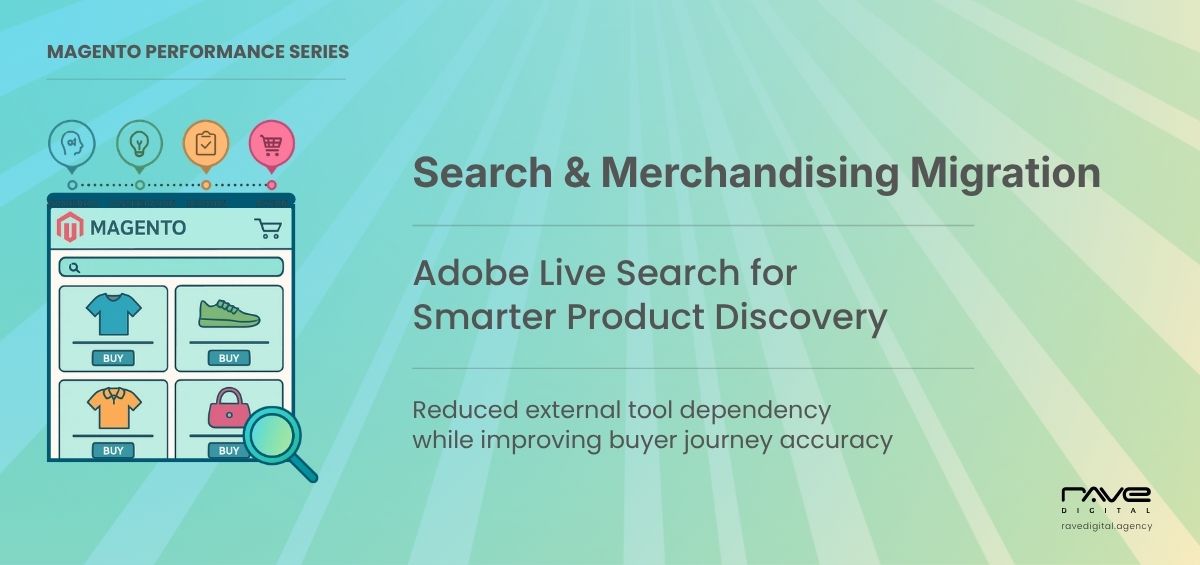
This use case focuses on how a Magento store planned a strategic move from a third-party search platform to Adobe Commerce Live Search to reduce search-related operating costs while preserving a strong customer search experience.
The goal was not just to replace one tool with another.
The real objective was to improve search efficiency, reduce unnecessary platform dependency, and keep product discovery smooth for shoppers.
The Search Challenge: Balancing Cost, Control, and Customer Experience
A strong Magento search experience should help shoppers find products even when they use broad terms, spelling variations, incomplete phrases, or generic product descriptions.
However, maintaining that experience through a separate third-party search tool can increase operational cost over time.
In this use case, the store was paying up to $2,000 per month for a third-party search and merchandising platform. The tool supported product discovery, but the recurring cost created a strong reason to evaluate whether similar value could be achieved within the Adobe Commerce ecosystem.
The challenge was clear:
Reduce search platform costs without weakening the customer experience.
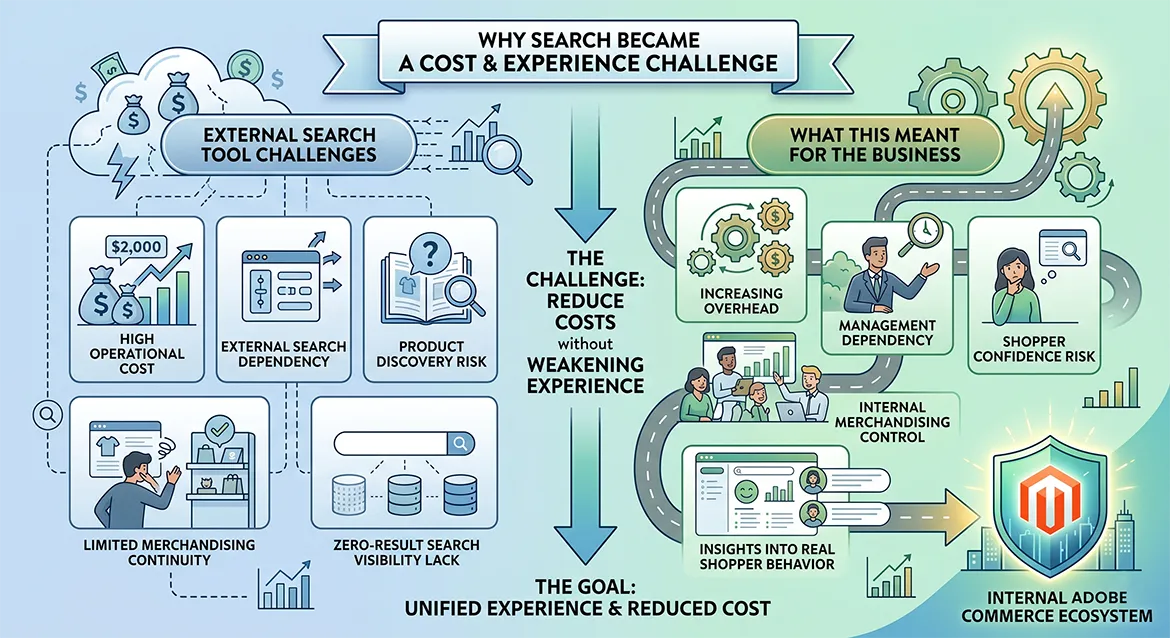
What This Meant for the Business
| Challenge | Business Impact |
|---|---|
| Recurring third-party search cost | Monthly platform expenses continued to increase operational overhead |
| External search dependency | Search management depended on an additional tool outside Adobe Commerce |
| Product discovery risk | Any migration had to protect shopper confidence and search quality |
| Merchandising continuity | Internal teams still needed control over product visibility and promotions |
| Zero-result search visibility | Teams needed insight into searches that failed to return helpful results |
| Spelling and broad-term searches | Search needed to support real shopper behavior, not only exact keywords |
For merchants, the risk is not only financial.
If the migration is handled poorly, search quality can drop, product visibility can suffer, and shoppers may struggle to find what they are ready to buy.
The Core Problem: Search Cost Was Growing Without Enough Platform Efficiency
The main issue was not that the existing search tool failed.
The issue was that the business was carrying the cost and complexity of an external search system while already operating within Adobe Commerce.
Over time, this created three concerns.
First, the recurring monthly cost increased the total cost of ownership.
Second, search and merchandising workflows required coordination across more systems.
Third, the business needed to make sure any future search strategy could support growth without adding unnecessary platform complexity.
The opportunity was to evaluate whether Adobe Commerce Live Search could support the store’s search and merchandising needs while reducing dependency on a separate third-party tool.
The Search Migration Approach
1. Reviewing Current Search Behavior Before Making the Switch
Before moving search platforms, it was important to understand what the existing search experience was doing well.
A search migration should not begin with a tool replacement.
It should begin with a review of shopper behavior, internal merchandising needs, search result quality, and business-critical features.
The review focused on areas such as:
- Common search terms
- Broad product searches
- Spelling variations
- Zero-result searches
- Promoted products
- Merchandising rules
- Category-level discovery
- Search result relevance
- Internal team workflows
This helped identify which search capabilities needed to be preserved after migration.
Merchant Impact
| Before Review | After Review |
|---|---|
| Search relied heavily on third-party configuration | Key search behaviors were documented |
| Migration risk was unclear | Critical product discovery needs were identified |
| Merchandising workflows were tied to the current tool | Rules and priorities could be mapped more carefully |
| Zero-result search data needed continuity | Reporting needs were included in planning |
For merchants, this step is important because search migration should protect what customers already rely on.
2. Moving Toward Adobe Commerce Live Search
The next step was planning the move from the third-party search platform to Adobe Commerce Live Search.
Because Live Search is part of the Adobe Commerce ecosystem, it offered a way to bring search functionality closer to the core platform while reducing reliance on an external paid solution.
The migration approach focused on preserving product discovery quality while simplifying long-term platform management.
Key areas included:
The goal was to ensure shoppers could continue finding products quickly while internal teams retained enough control over how products appeared in search results.
3. Preserving the Features That Matter Most
A successful Magento search migration is not only about turning on a new search tool.
It is about protecting the features that affect real shopping behavior.
The most important search and merchandising capabilities included:
| Search Capability | Why It Matters |
|---|---|
| Fuzzy search | Helps shoppers find products even when search terms are not exact |
| Auto-correct support | Reduces lost searches caused by spelling mistakes |
| Zero-result reporting | Helps teams identify gaps in product data or search relevance |
| Merchandising rules | Allows teams to boost, pin, or promote important products |
| Search relevance controls | Helps improve the quality of results shown to shoppers |
| Adobe Commerce alignment | Reduces tool fragmentation and simplifies management |
For merchants, these capabilities directly affect product discovery, buyer confidence, and conversion potential.
A shopper may not know how the search system works.
They only care whether the right product appears quickly.
4. Reducing Platform Dependency Without Weakening Search
The main business value of this migration was not just cost reduction.
It was the combination of cost control, search continuity, and platform simplification.
By moving toward Adobe Commerce Live Search, the store could reduce dependency on a separate third-party search tool while keeping search and merchandising closer to the Magento ecosystem.
Before vs. After
| Before Migration | After Migration Planning |
|---|---|
| Search depended on a separate third-party platform | Search moved closer to the Adobe Commerce ecosystem |
| Monthly tool cost added operational overhead | Search cost structure became easier to control |
| Merchandising required external platform management | Search and merchandising became more centralized |
| Migration risk needed careful review | Key search features were mapped for continuity |
| Product discovery depended on tool-specific workflows | Search strategy became more aligned with the commerce platform |
For merchants, the benefit is a more efficient search setup that supports both customer experience and operational cost control.
The Result: A More Cost-Efficient Product Discovery Strategy
By planning the transition from a third-party search tool to Adobe Commerce Live Search, the store created a stronger foundation for long-term search management.
The expected result was a search experience that preserved important product discovery features while reducing recurring platform costs and simplifying search operations.
Improvement Area and Business Outcome
| Improvement Area | Business Outcome |
|---|---|
| Search platform migration | Reduced dependency on an external search solution |
| Cost optimization | Created an opportunity to eliminate up to $2,000/month in third-party search cost |
| Product discovery continuity | Preserved important search behaviors shoppers rely on |
| Merchandising support | Maintained control over promoted and prioritized products |
| Zero-result visibility | Supported ongoing catalog and search improvement |
| Platform alignment | Brought search closer to the Adobe Commerce ecosystem |
Most importantly, the migration helped balance cost reduction with customer experience protection.
The store did not need to choose between reducing operating cost and maintaining search quality.
It could work toward both.
What Magento Merchants Can Learn From This Use Case
For Magento and Adobe Commerce merchants, search is not just a website feature.
It is a conversion path.
When shoppers use search, they often have stronger buying intent. If search results are inaccurate, incomplete, or hard to navigate, that intent can quickly disappear.
A strong search strategy should help merchants:
- Improve product discovery
- Reduce zero-result searches
- Support spelling mistakes
- Improve search relevance
- Preserve merchandising control
- Reduce unnecessary third-party tool dependency
- Lower recurring platform costs
- Align search with the core Adobe Commerce ecosystem
The biggest takeaway is simple:
Search migration should not only reduce cost. It should protect how shoppers find and buy products.
Is Your Magento Search Experience Costing More Than It Should?
If your Magento store is experiencing:
- High third-party search platform costs
- Poor product discovery
- Too many zero-result searches
- Weak search relevance
- Search result management challenges
- Spelling-related search failures
- Merchandising limitations
- Tool dependency across search workflows
It may be time to review whether your current search setup is supporting both customer experience and operational efficiency.
At Rave Digital, we help Magento and Adobe Commerce merchants improve site search, product discovery, merchandising workflows, search relevance, and platform efficiency.
Ready to Improve Magento Search and Product Discovery?
Reduce search complexity, improve product findability, and create a more cost-efficient product discovery experience with Adobe Commerce Live Search.