







AI Can Speed Up Development, but It Cannot Replace Accountability
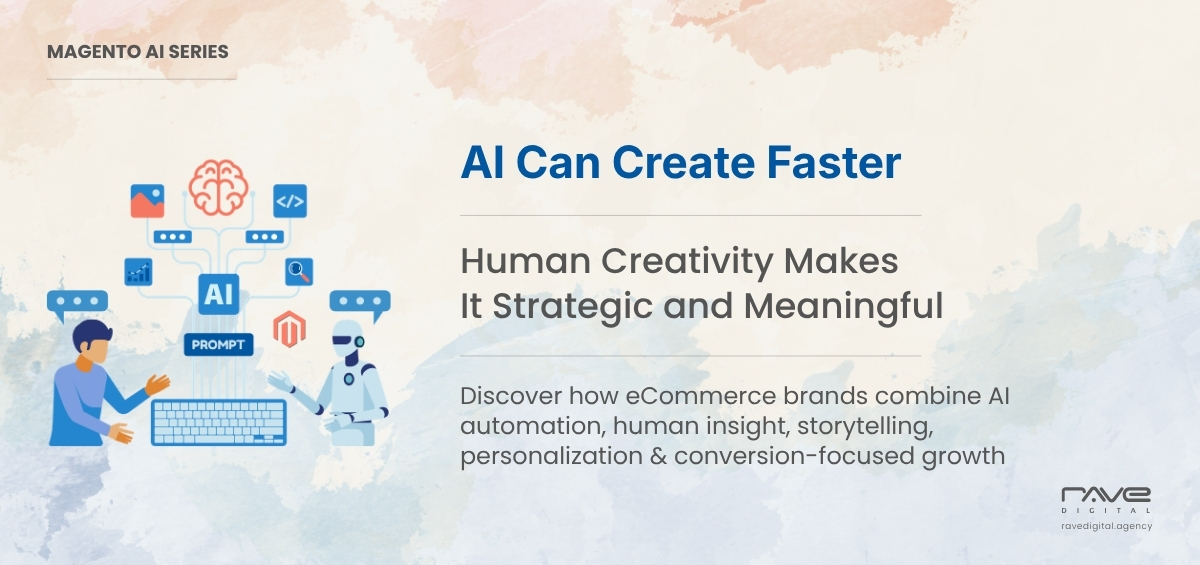
AI coding for Magento can help development teams move faster.
It can generate code snippets, suggest logic, create boilerplate, write test cases, explain errors, and support repetitive development tasks. For busy Magento and Adobe Commerce development teams, this speed can be valuable.
But faster code is not always safer code.
Magento stores are complex commerce environments. A small change can affect checkout, catalog performance, customer data, pricing rules, integrations, extensions, cron jobs, APIs, or admin workflows. If AI-generated code is used without review, testing, and governance, it can introduce problems that are difficult to detect until they reach production.
That is why AI should not be treated as an autopilot for development.
It should be used as an assistant inside a controlled workflow.
Without the right guardrails, AI-generated code risks can become the next hidden source of technical debt.
Why AI Coding Needs Extra Caution in Magento Projects
Magento is not a simple website framework.
It is a layered ecommerce platform with modules, observers, plugins, dependency injection, layout XML, database schemas, indexing, caching, extension interactions, and multiple frontend and backend workflows.
This means code must follow Magento architecture carefully.
AI tools may generate code that looks correct but does not follow Magento best practices. It may use outdated methods, ignore dependency injection patterns, bypass platform conventions, or create logic that works in isolation but fails inside the full store environment.
In a Magento project, the question is not only, “Does this code run?”
The better question is, “Will this code remain stable across checkout, catalog, integrations, upgrades, security checks, and real customer workflows?”
That is where Magento development guardrails become essential.
Where AI-Generated Code Can Create eCommerce Risk
AI-assisted coding can support productivity, but it can also create risk when teams use generated output without proper validation.
| AI Coding Risk | Why It Matters | Guardrail |
|---|---|---|
| Incorrect Magento patterns | Code that ignores Magento architecture can break store functionality, create conflicts, or behave unpredictably across modules. | Require review by experienced Magento developers or Magento-certified experts before implementation. |
| Security gaps | Unvalidated code may expose sensitive customer, order, payment, or admin data. | Run security checks, code quality scans, permission reviews, and input validation before deployment. |
| Performance-heavy code | Poor logic can slow checkout, catalog pages, search, cron jobs, APIs, or admin operations. | Test code against real store workflows, traffic conditions, cache behavior, and database impact. |
| Poor extension compatibility | AI-generated changes may conflict with third-party extensions, custom modules, or future upgrades. | Validate every change against the current architecture, installed extensions, and upgrade roadmap. |
| Unclear ownership | If teams do not document AI-assisted changes, future developers may struggle to maintain or troubleshoot them. | Document what was generated, what was modified, who reviewed it, and why it was approved. |
Faster Code Can Still Create Slower Stores
AI tools can generate working code quickly, but working code is not always efficient code.
In Magento, performance depends on how code interacts with the full platform. A small database query inside the wrong loop can slow category pages. A poorly written plugin can affect checkout.
Unnecessary frontend scripts can increase page load times. Inefficient API logic can slow integrations. A custom module can trigger extra processing during indexing or cache refresh.
These issues may not appear in a simple local test.
They often show up only when the code interacts with real catalog size, live order volume, customer sessions, third-party extensions, and production traffic.
That is why Magento performance optimization should be part of any AI-assisted development workflow.
AI can help create code faster, but teams still need to validate performance impact before pushing changes forward.
Security Review Is Non-Negotiable
Magento and Adobe Commerce stores handle sensitive business and customer data.
That may include customer profiles, addresses, order details, payment-related workflows, account permissions, admin access, API tokens, integration data, and pricing rules.
AI-generated code can create security problems if it does not properly sanitize inputs, validate permissions, handle authentication, follow Magento security standards, or protect sensitive data.
A code snippet may appear harmless, but if it exposes data, bypasses access controls, or mishandles user input, it can create serious risk.
This is why Magento security testing should be a required guardrail for AI-assisted development.
Before code reaches production, teams should review:
- Input validation
- Output escaping
- Admin permissions
- API access controls
- Customer data exposure
- Logging behavior
- Payment and checkout touchpoints
- Third-party integration security
- Dependency and package risks
AI can assist development, but security responsibility must remain with the development team.
Extension Compatibility Needs Human Review
Magento stores often depend on multiple third-party extensions and custom modules.
A change that works in one clean Magento instance may not work the same way in a live store with payment modules, shipping extensions, SEO tools, search integrations, feed generators, analytics scripts, ERP connections, and custom checkout logic.
AI tools may not fully understand the installed extension stack or the store’s specific architecture.
That creates compatibility risk.
For example, AI-generated code may override logic that another extension depends on. It may duplicate functionality that already exists. It may create conflicts during upgrades. It may work in one version but fail after a module update.
This is why Magento code review must include architecture awareness.
Reviewers need to understand how the change fits into the current store, not just whether the code looks clean.
AI Can Increase Technical Debt If Teams Skip Governance
Technical debt is not always created by bad intentions.
Sometimes it comes from fast decisions that are not documented, reviewed, or tested properly.
AI can increase this risk because it makes code creation easier. Teams may generate quick fixes, helper scripts, modules, or frontend changes without fully considering long-term maintenance.
Over time, this can create Magento technical debt.
The store may accumulate code that works today but becomes difficult to upgrade, debug, or extend later. Developers may not know why a change was made. Business teams may not understand the risk. Future updates may take longer because undocumented AI-assisted logic is buried inside the codebase.
Safe AI development requires governance.
Teams should define when AI can be used, how code must be reviewed, what documentation is required, and what approval process is needed before deployment.
The Guardrails Magento Teams Need Before Production
AI-assisted coding should be part of a structured development process, not a shortcut around it.
A safe workflow should include clear guardrails before any AI-generated or AI-assisted code reaches production.
1. Magento Architecture Review: Every AI-assisted change should be reviewed against Magento standards, module structure, dependency injection, plugin usage, layout changes, database logic, and extension compatibility.
This helps prevent code that works technically but does not belong in the platform architecture.
2. Security and Code Quality Checks: Teams should run automated scans and manual reviews to catch security gaps, poor validation, unsafe logic, unnecessary dependencies, and code quality issues.
This is especially important for checkout, customer accounts, admin workflows, and API-connected features.
3. Performance Testing: AI-generated code should be tested for real performance impact. Teams should review database queries, caching behavior, frontend weight, indexing impact, cron performance, and page load effects.
This helps protect Magento production stability before customers are affected.
4. Extension and Upgrade Validation: Every change should be checked against installed extensions, custom modules, current Magento version, and future upgrade plans.
This reduces the chance of creating compatibility issues that become expensive later.
5. Documentation and Ownership: Teams should document the purpose of the AI-assisted change, the prompt or logic used, the developer review, testing results, and approval status.
This makes future maintenance easier and keeps ownership clear.
How to Use AI Without Creating Technical Debt
AI can still be highly useful in Magento development when it is applied carefully.
The safest approach is to use AI for support tasks that improve speed without removing expert control.
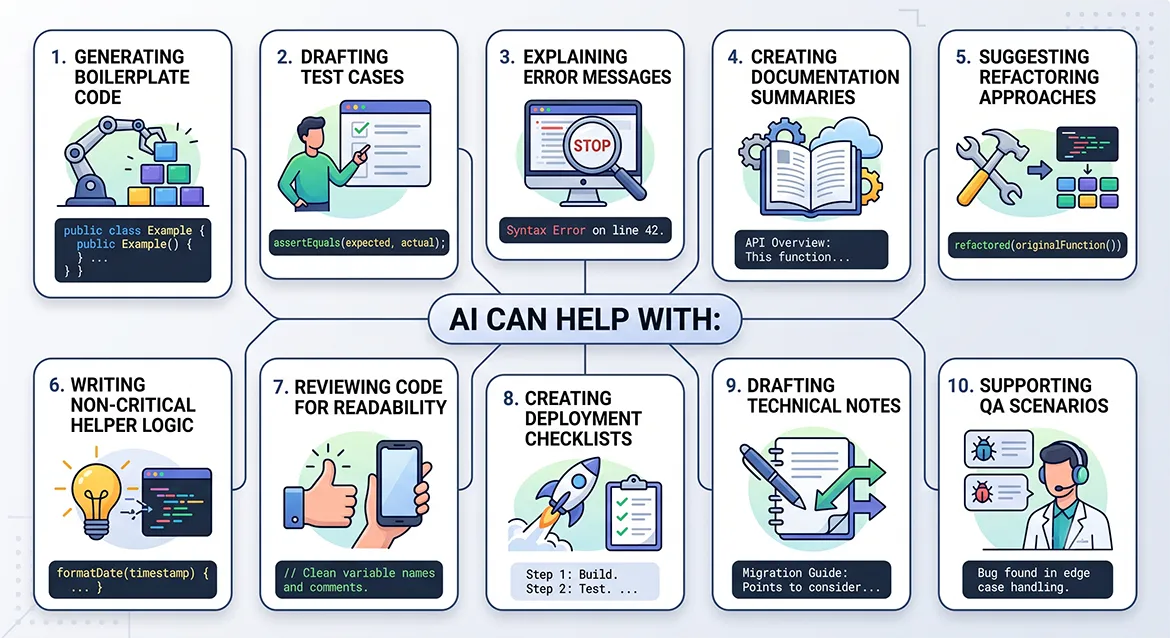
But human developers should lead areas that require platform judgment, business logic, security decisions, architecture planning, and production approval.
The goal is not to avoid AI.
The goal is to keep AI inside a disciplined development workflow.
Safe AI Development Starts With Review, Testing, and Governance
AI tools are changing how ecommerce teams work, but they do not remove the need for accountability.
For Magento and Adobe Commerce projects, safe AI use depends on three core principles: review, testing, and governance.
Review ensures that AI-assisted code follows Magento architecture and business requirements.
Testing confirms that the change works across real store workflows.
Governance makes sure teams know how AI is used, approved, documented, and maintained.
When these controls are in place, AI can help development teams move faster without creating unnecessary risk.
Without them, AI-generated code may save time upfront but create more work later.
AI Coding Should Support Better Development, Not Riskier Deployment
AI has real value in Magento development.
It can reduce repetitive work, support faster problem-solving, improve documentation, and help developers explore solutions more efficiently.
But Magento stores are too business-critical for unchecked code.
A production store needs stability, security, performance, and maintainability. That requires experienced developers, clear review processes, strong testing, and disciplined deployment workflows.
AI should help teams build smarter.
It should not become another hidden source of risk.
Build Safer AI-Assisted Magento Development Workflows
Using AI in Magento development?
Create safer workflows for AI-assisted coding, code review, testing, documentation, and deployment.