







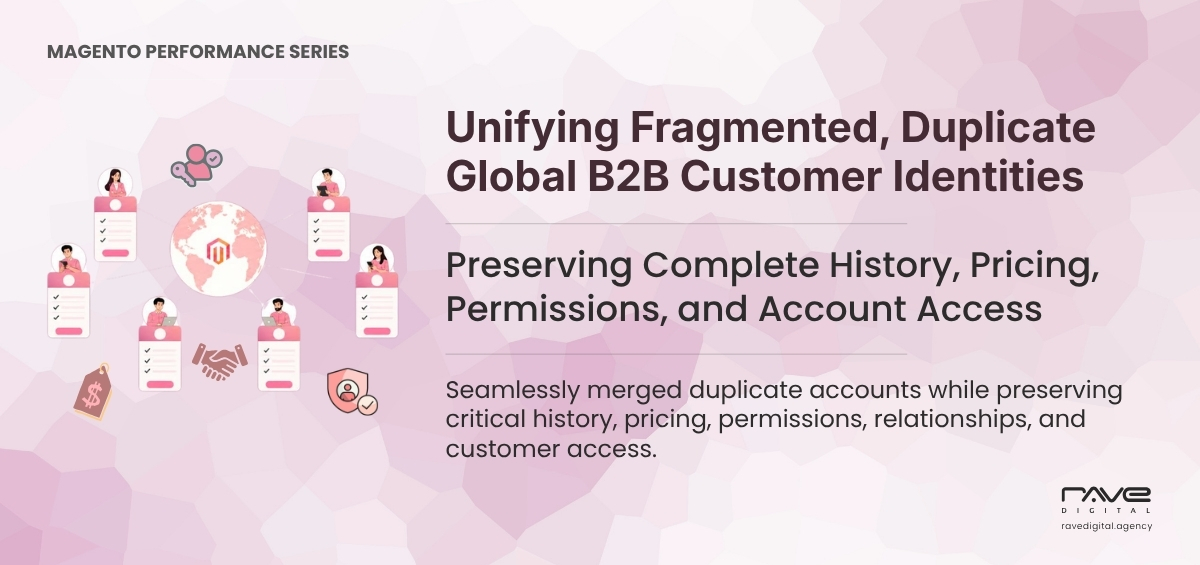
A Data Migration Framework for Unified Login, Historical Continuity, Pricing, and Access
B2B customer identity unification is rarely a simple import. When the same buyer has interacted with several stores, portals, regions, or business units, duplicate emails, company roles, order history, invoices, tax status, negotiated pricing, and catalog permissions may be distributed across records that look identical but represent different commercial relationships.
A unified commerce platform requires a dependable identity model. Yet resolving conflicts by deleting records or choosing one account arbitrarily can detach history, remove entitlements, expose incorrect pricing, and force customers to rebuild established relationships.
The objective is to produce one governed customer identity while preserving the operational meaning attached to the legacy records.
Why Duplicate B2B Customer Data Is More Than a Database Problem
In B2B commerce, a customer record can determine what a buyer is allowed to purchase, which prices apply, whether tax is charged, who can approve orders, and which historical documents are visible. Deduplication therefore affects authentication, finance, service, sales, and customer experience.
Matching solely on email address is often insufficient. Shared inboxes, changed contacts, subsidiaries, buying teams, and portal-specific roles can create both false matches and missed matches. Business rules and human review are needed for ambiguous identities.
What This Meant for the Business
| Challenge | Business Impact |
|---|---|
| Identical emails across portals or storefronts | Records conflict with a unified identity model |
| History divided across accounts | Customers and service teams lose transaction context |
| Different company roles or permissions | Users may receive too much or too little access |
| Negotiated pricing and tax status | Incorrect attributes affect orders and margins |
| Separate login destinations | Customers face avoidable access and support friction |
The Core Problem: Preserving Commercial Meaning While Removing Duplicates
Duplicate records are not always redundant copies. One may hold invoices, another may contain current addresses, and another may define pricing or service eligibility. The identity-resolution process must determine which identity survives, which attributes take precedence, and how history remains connected.
The work becomes more complex when separate portal experiences are replaced by one primary commerce destination. Access previously controlled by a URL must be recreated through company roles, customer groups, catalog permissions, pricing rules, and entitlements.
The Solution: A Governed B2B Identity Unification Framework
1. Inventory All Customer Sources
Document every storefront, portal, CRM, ERP, service system, and offline process that creates or updates customer information. Identify the system of record for each attribute.
2. Define Match and Conflict Rules
Use more than one identifier where possible. Establish exact-match, probable-match, and manual-review rules using email, company, address, account number, tax ID, phone, or other appropriate fields.
3. Select a Survivorship Model
Define which record becomes the primary identity and which source wins for names, addresses, company relationships, tax status, permissions, and communication preferences. Preserve an audit trail of merged identifiers.
4. Preserve Orders, Invoices, and Account History
Reconnect historical records to the surviving identity without changing their financial meaning. Validate that customers and internal teams can still find the documentation they need.
5. Rebuild B2B Access and Pricing Logic
Translate portal-specific behavior into governed company roles, customer groups, catalog permissions, negotiated pricing, payment terms, tax rules, and service entitlements.
6. Plan Authentication Continuity
Decide how passwords, activation emails, multi-factor authentication, account invitations, and shared company users will work after migration. Communicate changes before customers encounter them.
7. Test Representative Customer Types
Validate ordinary buyers, administrators, approvers, tax-exempt accounts, negotiated-price customers, service users, and edge cases. Check both present entitlements and historical visibility.
Before and After
| Area | Fragmented State | Governed State |
|---|---|---|
| Identity | Same customer represented by several records | One primary identity with traceable merged records |
| Login | Separate portals and credentials | Unified authentication journey |
| History | Orders and invoices divided across accounts | Historical records connected to the surviving identity |
| Pricing and tax | Eligibility stored inconsistently | Rules assigned through governed attributes and groups |
| Catalog access | Controlled by legacy portal location | Controlled through roles, permissions, and entitlements |
| Support | Teams compare conflicting records | One account provides clearer customer context |
The Result: A More Reliable B2B Customer Operating Model
| Improvement Area | Business Outcome |
|---|---|
| Data integrity | Duplicate and conflicting identities are reduced |
| Customer continuity | Buyers retain access to relevant history and relationships |
| B2B governance | Roles, pricing, tax, and catalog eligibility become explicit |
| Customer experience | One login supports the appropriate account journey |
| Operational clarity | Sales, service, and finance work from more consistent records |
| Future scalability | New channels can connect to a cleaner identity foundation |
What Magento Merchants Can Learn
- Treat identity unification as customer-relationship design, not a one-field cleanup.
- Define survivorship and attribute precedence before moving data.
- Preserve source identifiers and merge history for traceability and recovery.
- Rebuild portal-based access as explicit roles, groups, permissions, and entitlements.
- Test current pricing and access together with historical orders and invoices.
- Create an exception process for ambiguous records instead of forcing automated matches.
FAQs
Why do duplicate emails complicate a Magento migration?
A unified platform needs dependable ownership for authentication and account data. Duplicate emails create uncertainty about which record owns history, pricing, permissions, and company relationships.
Should customer records be merged using email alone?
Usually not. Email is useful, but company, address, account number, tax identifier, phone, and business rules may be needed to reduce false matches.
What history should be preserved?
Orders, invoices, addresses, company relationships, tax status, credit or payment attributes, catalog permissions, and other records needed for service and operations should be evaluated.
How can separate B2B portals become one login experience?
Their access rules can be translated into company roles, customer groups, catalog permissions, pricing logic, and entitlements within one commerce destination.
What should be tested after identity unification?
Authentication, invitations, company relationships, roles, pricing, tax status, catalog visibility, orders, invoices, addresses, and representative edge cases should be tested.
Turn Fragmented Customer Records Into a Governed B2B Experience
Rave Digital can help assess duplicate identities, source systems, transaction history, customer groups, pricing rules, and access requirements before a Magento migration.